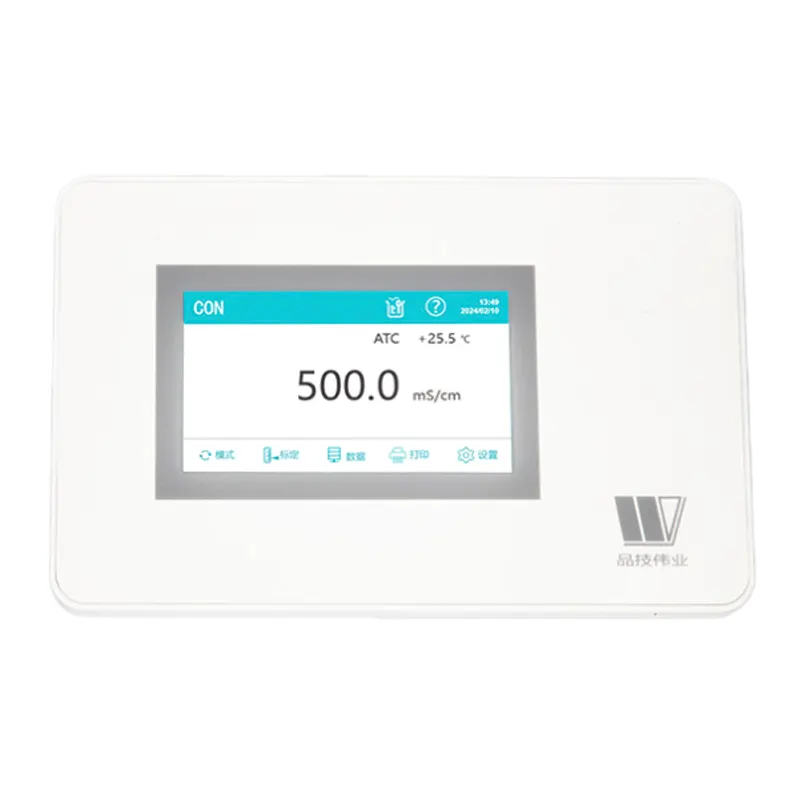
The DDS-411 is a benchtop conductivity meter with a 4.3-inch color TFT touchscreen, measuring conductivity (0.05 μS/cm to 500.0 mS/cm), resistivity, TDS, salinity and temperature. Features 1500-point data storage, GLP printing, USB/RS232 connectivity and automatic frequency and range switching. Supplied with DJS-1N conductivity electrode and T-820D temperature probe.
The DDS-411 benchtop conductivity meter is a compact, capable instrument for multiparameter water quality measurement in laboratory and quality control environments. Sharing the same measurement specifications as the DDS-421, it measures conductivity, resistivity, TDS, salinity and temperature across the same wide range — packaged in a smaller footprint with a 4.3-inch color TFT touchscreen.
With a conductivity range of 0.05 μS/cm to 500.0 mS/cm and automatic frequency and range switching, the DDS-411 handles ultrapure water, standard laboratory samples and higher-concentration solutions without manual range adjustment. Auto temperature compensation from -5.0°C to 110.0°C via the included T-820D probe ensures accurate readings across varying sample temperatures.
The DDS-411 includes 1500-point data storage, GLP-compliant printing and USB/RS232 connectivity, making it suitable for laboratories that need data traceability without the three-level user management system of the DDS-421. It is well suited to single-operator laboratory environments, teaching facilities and quality control stations where benchtop conductivity measurement is needed alongside reliable data recording.
| Model | DDS-411 | |
| Measuring Range | Conductivity | 0.05 μS/cm – 500.0 mS/cm |
| Resistivity | 5.00 Ω·cm – 20.00 MΩ·cm | |
| TDS | 0.000 mg/L – 100 g/L | |
| Salinity | 0.00 – 8.00 % | |
| Temperature | -5.0 ~ 110.0 °C | |
| Accuracy (±) | Conductivity | ±0.5% FS |
| Resistivity | ±0.5% FS | |
| TDS | ±0.5% FS | |
| Salinity | ±0.1% | |
| Temperature | ±0.2 °C | |
| Included Sensor | DJS-1N (black) + T-820D | |
| Optional Sensors | DJS-0.01 / DJS-0.1 / DJS-1 (bright) / DJS-10 | |
| Electrode Connector | BNC / RCA | |
| Display | 4.3″ Color TFT Touchscreen | |
| Electrode Holder | Included | |
| Temperature Compensation | (-5.0 ~ 110.0) °C Auto / Manual | |
| Calibration | 1–3 point standard solution / Electrode constant | |
| Standard Solutions | 146.5 μS/cm / 1408.3 μS/cm / 12.852 mS/cm / 111.31 mS/cm | |
| Data Storage | 1500 data points | |
| Connectivity | USB + RS232 | |
| Printing | GLP-compliant format | |
| User Management | — | |
| Date / Time | Yes | |
| Prompt Tone | On / Off | |
| Power Supply | DC 12V | |
| Operating Temperature | 5°C ~ 40°C | |
| Relative Humidity | ≤80% | |
| Dimensions (mm) | Approx. 200 × 130 × 60 mm | |
| Weight (kg) | 1 | |
The DDS-411 and DDS-421 share identical measurement specifications, parameter range, data storage and connectivity. The DDS-421 has a larger 7-inch touchscreen and includes three-level user management (Administrator / User / Visitor) with password protection. The DDS-411 uses a 4.3-inch touchscreen and does not include user management. Choose the DDS-411 for single-operator or space-constrained applications; choose the DDS-421 for regulated multi-operator environments where access control and audit trails are required.
The DDS-411 measures five parameters: conductivity, resistivity, TDS, salinity and temperature. Automatic frequency and range switching ensures the correct measurement conditions are applied across the full 0.05 μS/cm to 500.0 mS/cm range without manual adjustment.
The included DJS-1N (black) electrode covers 2–20000 μS/cm and is suitable for most standard water quality and laboratory conductivity measurement. For ultrapure or very low-conductivity samples (below 2 μS/cm), use the optional DJS-0.1 electrode. For high-conductivity industrial solutions above 20000 μS/cm, use the optional DJS-10. Contact us for guidance on electrode selection for specific applications.
Salinity is calculated from the conductivity reading using a built-in conversion algorithm. The DDS-411 displays salinity in percentage (0.00–8.00%), suitable for seawater analysis, brackish water monitoring and aquaculture applications. No additional electrode or configuration is required beyond the standard conductivity setup.
Yes, with the appropriate electrode. The DDS-421’s maximum resistivity range is 20.00 MΩ·cm, which covers typical ultrapure water specifications (>1 MΩ·cm for laboratory grade, >18 MΩ·cm for ASTM Type 1). For ultrapure water measurement, use the optional DJS-0.1 electrode (cell constant 0.1) rather than the included DJS-1N, to ensure accuracy at very low conductivity values.
The DDS-411 has USB and RS232 ports. Connect via USB to export measurement records in CSV format for import into LIMS, Excel or other data management systems. RS232 supports connection to serial printers for GLP-compliant hard-copy output. All stored records include date and time stamp for data traceability.
Before You Go — Get a Free Quote