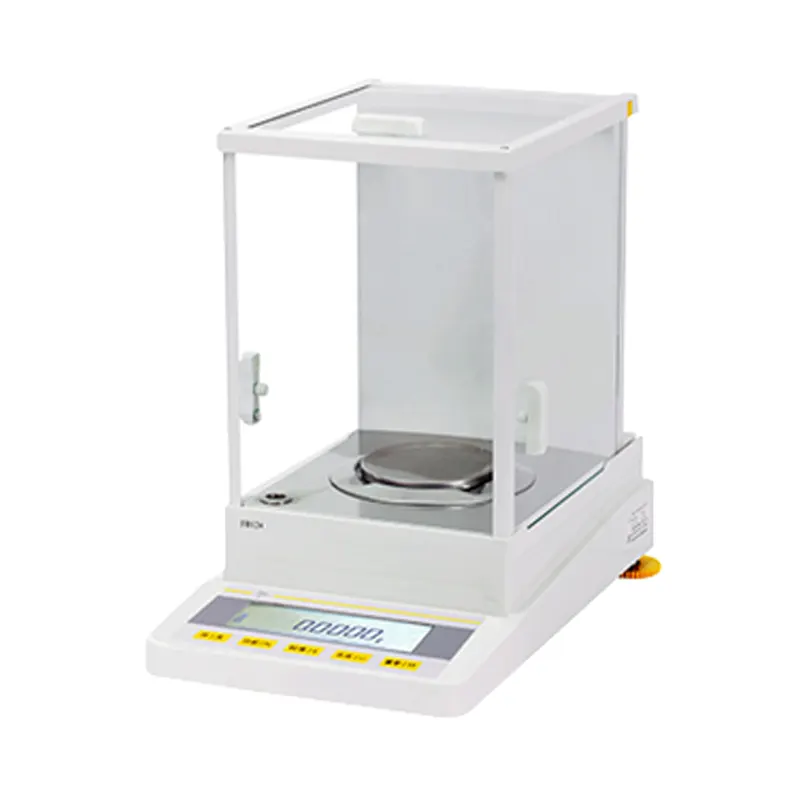
The FA Series analytical balances use modular electromagnetic force sensor technology to deliver 0.1mg (0.0001g) readability across five models from 110g to 320g capacity. Features include glass draft shield with transport lock, RS232 and USB interfaces, dynamic temperature compensation, piece counting, percentage weighing and below-balance weighing hook. Suited to pharmaceutical, chemical, research and precision laboratory weighing applications.
The FA Series analytical balances are high-precision weighing instruments designed for applications where measurement accuracy at the 0.1mg level is essential. Built around a modular electromagnetic force balance sensor — the same technology used in leading international analytical balance brands — the FA Series delivers consistent, repeatable results across all five models, from the 110g FA1104 to the 320g FA324.
The glass draft shield with transport lock is a critical feature for analytical weighing, protecting the sample from air movement that can cause unstable readings. Combined with four-level shock absorption, adjustable weighing speed and dynamic temperature compensation, the FA Series maintains accuracy even in environments subject to vibration or temperature fluctuation — common challenges in busy laboratory settings.
Both RS232 and USB interface modules are included, enabling direct connection to a printer or PC for data output, record keeping and LIMS integration. Bi-directional communication allows remote control of the balance from connected software. Independent tare and zero keys, adjustable auto-zero tracking and a full-range tare function support efficient workflows in high-throughput laboratory environments.
Beyond standard weighing, the FA Series supports piece counting, percentage weighing and multiple unit conversion, extending its usefulness to formulation, quality control and materials testing applications.
| Model | FA124 | FA224 | FA324 | FA1104 | FA2104 |
| Maximum Capacity (g) | 120 | 220 | 320 | 110 | 120 |
| Readability (g) | 0.1 | 0.1 | 0.1 | 0.1 | 0.1 |
| Repeatability (<=g) | ± 0.1 | ± 0.1 | ± 0.1 | ± 0.1 | ± 0.1 |
| Linearity (<=g) | ± 0.2 | ± 0.2 | ± 0.2 | ± 0.2 | ± 0.2 |
| Weighting Pan (mm) | Ф 90 | Ф 90 | Ф 90 | Ф 90 | Ф 90 |
| Gross Weight (kg) | 8 | ||||
| Net Weight (kg) | 6 | ||||
| Overall Dimensions (mm) | 365 × 223 × 338 | ||||
| Shipping Dimensions (mm) | 500 × 310 × 450 | ||||
The FA Series are analytical balances with 0.1mg (0.0001g) readability, using electromagnetic force sensors and enclosed glass draft shields — designed for high-accuracy weighing of small quantities in controlled laboratory environments. The MP Series are precision balances with 0.01g or 0.1g readability — 100 to 1000 times coarser — covering larger capacities up to 6100g for general-purpose laboratory and industrial use. Choose the FA Series when weighing accuracy at the sub-milligram level is required; choose the MP Series for routine laboratory or industrial weighing at higher capacities.
At 0.1mg readability, even minor air currents from air conditioning, ventilation or nearby movement can cause readings to fluctuate by several tenths of a milligram. The glass draft shield encloses the weighing chamber to eliminate air movement around the sample, ensuring stable, accurate readings. The transport lock secures the pan mechanism during movement to protect the sensitive sensor from shock damage.
The electromagnetic force sensor in the FA Series is sensitive to temperature changes, which can cause the balance reading to drift if ambient temperature changes during use. Dynamic temperature compensation continuously monitors and corrects for temperature-induced measurement error, maintaining accuracy across the balance’s operating temperature range without requiring manual recalibration when the ambient temperature shifts.
The FA Series includes both RS232 and USB interface modules as standard. RS232 supports connection to serial printers for hard-copy records. USB enables direct connection to a PC for data transfer and software control. Both interfaces support bi-directional communication, allowing the balance to be controlled remotely from connected software — useful for automated workflows and laboratory information management systems (LIMS).
Yes. The built-in below-balance weighing hook enables density determination using the Archimedes (liquid immersion) method. The sample is weighed in air, then suspended in a liquid of known density via the hook, and the balance calculates density from the two readings. No additional accessories are required for this function beyond a suitable liquid vessel and suspension kit.
Keep the glass draft shield closed when not in use. Clean the weighing pan and draft shield regularly with a soft, lint-free cloth — avoid solvents that may damage the glass or housing. Level the balance before each use using the built-in spirit level and adjustable feet. Perform auto calibration at the start of each working session, after moving the balance, or when ambient temperature changes significantly. Store with the transport lock engaged if the balance will be moved or shipped.
Before You Go — Get a Free Quote