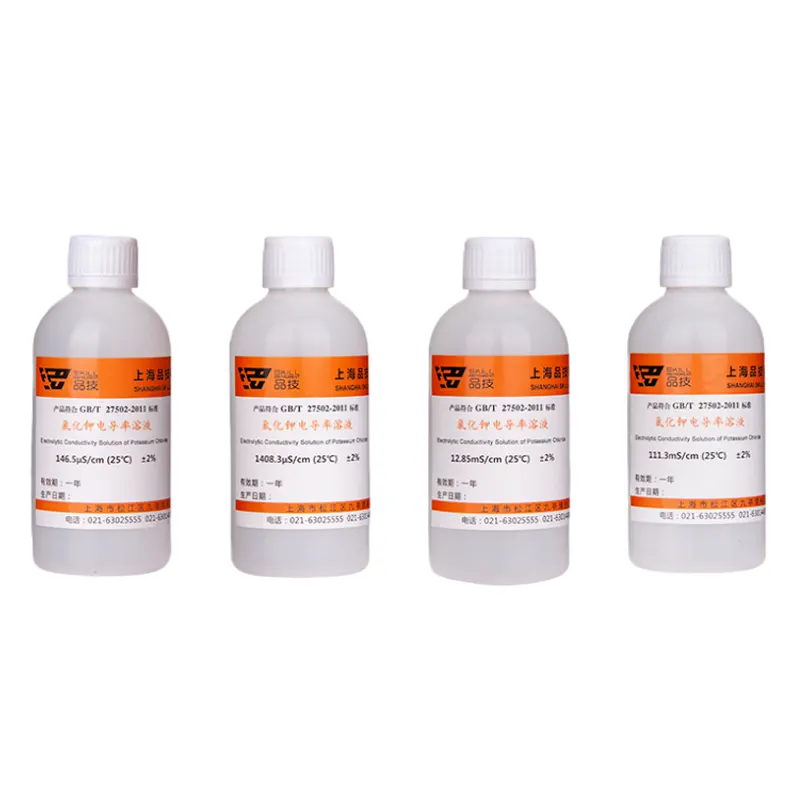
Skill Scientific conductivity standard solutions are available in four values — 146.5 μS/cm, 1408 μS/cm, 12.85 mS/cm and 111.3 mS/cm — for calibration of all Skill Scientific conductivity meters. Ready-to-use liquid format, 250mL per bottle. Directly correspond to the four built-in standard solution calibration points on the DDS-421, DDS-411, DDS-401, DDB-411 and DDB-11A instruments.
Accurate pH measurement depends on reliable calibration, and calibration is only as accurate as the buffer solutions used. Skill Scientific pH buffer solutions and sachets are formulated to traceable standards and are compatible with all Skill Scientific pH meters — as well as most other laboratory pH instruments — providing a convenient, trusted calibration consumable for routine laboratory and field use.
Three pH values are available — pH 4.00, 6.86 and 9.18 — covering the standard calibration points for 1, 2 and 3 point calibration across the full working range of most laboratory pH electrodes. All three values correspond to the JJG119 Chinese national standard and are automatically recognised by the buffer Auto-ID function on all Skill Scientific touchscreen and LCD pH meters.
Buffer solutions are available in two formats to suit different working environments. Powder sachets offer extended shelf life and are easy to transport and store — each sachet is dissolved in purified water to prepare a fresh 250mL buffer solution as needed, minimising waste and ensuring a fresh, uncontaminated calibration standard every time. Ready-to-use liquid solutions in 250mL and 500mL bottles are available for laboratories that calibrate frequently and prefer the convenience of a pre-made solution.
| Product | Conductivity Value | Format | Volume |
| Conductivity Standard Solution | 146.5 μS/cm | Ready-to-use liquid | 250mL / bottle |
| Conductivity Standard Solution | 1408 μS/cm | Ready-to-use liquid | 250mL / bottle |
| Conductivity Standard Solution | 12.85 mS/cm | Ready-to-use liquid | 250mL / bottle |
| Conductivity Standard Solution | 111.3 mS/cm | Ready-to-use liquid | 250mL / bottle |
Select the standard solution with a conductivity value closest to your expected sample range. As a general guide: use 146.5 μS/cm for drinking water, low-conductivity environmental water and pure water monitoring; use 1408 μS/cm for standard laboratory water quality and general environmental samples; use 12.85 mS/cm for process water, cooling water and mid-range industrial applications; use 111.3 mS/cm for high-conductivity industrial solutions and brines. For multi-point calibration across a wide sample range, use two or three standard solutions bracketing the expected measurement range.
Yes. The four conductivity values (146.5 μS/cm, 1408 μS/cm, 12.85 mS/cm and 111.3 mS/cm) are standard international calibration reference values used across the conductivity meter industry. These solutions are compatible with conductivity meters from all major manufacturers that calibrate at or near these values. They are automatically matched to the built-in reference values on Skill Scientific DDS and DDB series instruments.
A typical single calibration requires 20–50mL of the selected standard solution. A 250mL bottle provides enough solution for 5 to 12 calibration sessions. For multi-point calibration using two or three values, the total volume required per session is proportionally higher. Discard the used standard solution after each calibration — do not return it to the original bottle to avoid contamination.
Store bottles in a cool, dry location away from direct sunlight and extreme temperatures. Keep bottles tightly sealed when not in use. Avoid contact between the solution and the conductivity electrode during storage. Check the expiry date printed on the label before use — conductivity standard solutions can change value over time due to evaporation or absorption of CO₂ from the air, which affects accuracy. Discard any solution that has exceeded its shelf life or shows signs of contamination or discolouration.
Standard solution calibration uses a reference liquid of known conductivity to verify and correct the instrument reading directly — it accounts for both electrode condition and any drift in the measurement circuit. Electrode constant calibration sets the cell constant of the electrode mathematically, without using a reference solution. For routine laboratory and field use, standard solution calibration is recommended as it provides a more complete verification of measurement accuracy. Electrode constant calibration is used when a specific non-standard electrode is installed or when standard solutions of the required value are not available.
Before You Go — Get a Free Quote