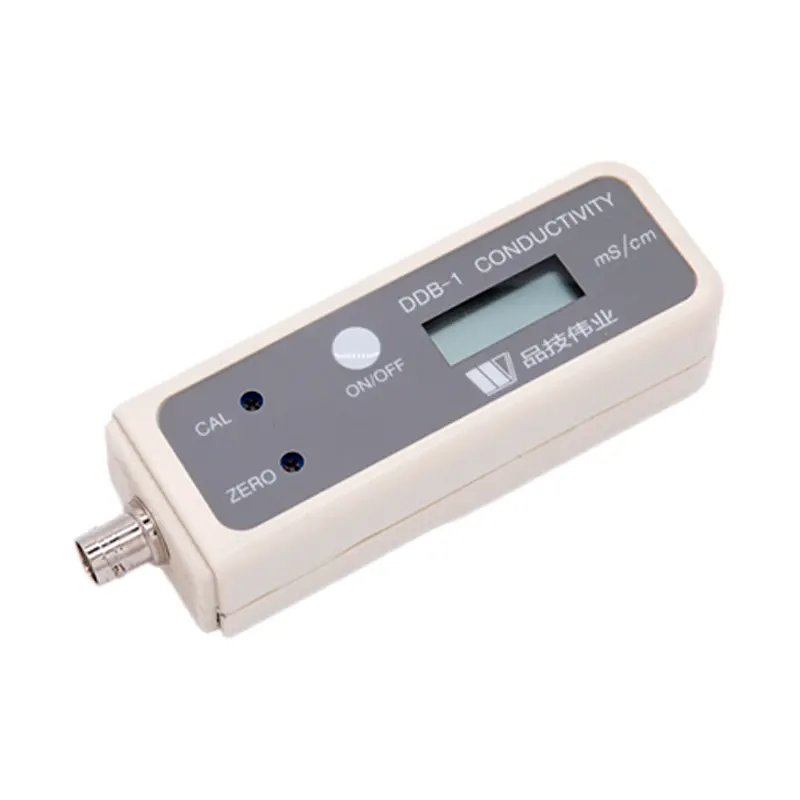
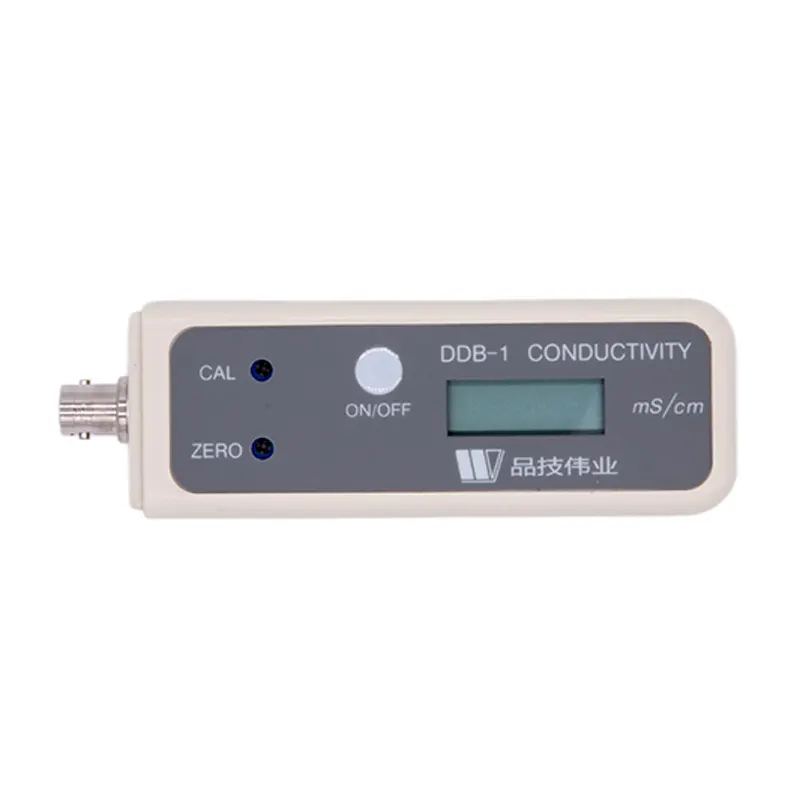
The DDB-1 is a lightweight handheld conductivity meter with LCD display, measuring conductivity from 0 to 10.00 mS/cm with ±1% FS accuracy. Features electrode constant calibration and BNC electrode connection. At 120×40×34 mm and 0.2 kg, it is one of the most compact conductivity meters in the Skill Scientific range.
The DDB-1 portable conductivity meter is a simple, pocket-sized handheld instrument for basic conductivity measurement in the field, on production lines and in educational settings. Measuring just 120×40×34 mm and weighing 0.2 kg, it is the most compact conductivity meter in the Skill Scientific range — easy to carry in a pocket or field kit and requiring no bench, power outlet or complex setup.
The DDB-1 covers a focused conductivity range of 0 to 10.00 mS/cm, making it well suited to freshwater quality checks, drinking water monitoring, aquaculture, irrigation water testing and general-purpose on-site conductivity screening where sample conductivity falls within this range. Electrode constant calibration allows accurate measurement with the included DDB-1 (black) electrode.
Without temperature compensation, data storage or connectivity, the DDB-1 is designed purely for quick, direct readings — results are read from the LCD display and recorded manually. For applications requiring temperature compensation, wider measurement range, data storage or field printing, the DDB-11A or DDB-411 are the recommended alternatives.
| Model | DDB-1 |
| Measuring Range | 0 ~ 10.00 mS/cm |
| Accuracy (±) | ±1% FS |
| Included Sensor | DDB-1 (black) |
| Optional Sensors | — |
| Electrode Connector | BNC |
| Display | LCD |
| Electrode Holder | — |
| Temperature Compensation | — |
| Calibration | Electrode Constant |
| Data Storage | — |
| Connectivity | — |
| Printing | — |
| Power Supply | DC 9V |
| Operating Temperature | 10°C ~ 30°C |
| Relative Humidity | ≤80% |
| Dimensions (mm) | Approx. 120 × 40 × 34 mm |
| Weight (kg) | 0.2 |
Both are compact handheld conductivity meters with the same form factor (120×40×34 mm, 0.2 kg), LCD display and basic operation. The key difference is measurement range: the DDB-1 covers 0 to 10.00 mS/cm for general water quality applications, while the DDB-2 covers the much narrower range of 0.0 to 199.9 μS/cm — optimised for very low-conductivity samples such as purified water, rainwater and distilled water. Choose the DDB-1 for standard freshwater and general-purpose use; choose the DDB-2 specifically for pure or low-conductivity water monitoring.
The DDB-11A has a wider measurement range (0.00 μS/cm to 100.0 mS/cm), manual temperature compensation (10–40°C), a larger body (180×80×40 mm) and supports optional electrode changes. The DDB-1 covers 0 to 10.00 mS/cm only, has no temperature compensation, uses the dedicated DDB-1 electrode and is more compact (120×40×34 mm, 0.2 kg). Choose the DDB-1 for simple freshwater spot checks in the most compact possible form; choose the DDB-11A for wider-range or temperature-compensated measurements.
No. The DDB-1 does not have a temperature measurement or compensation function. It is intended for use at ambient operating temperatures of 10–30°C. For applications where sample temperature varies and compensation is needed, the DDB-11A (manual compensation, 10–40°C) or DDB-411 (auto/manual, -5.0–110.0°C) are recommended.
The DDB-1 is suited to general freshwater quality spot checks, drinking water and tap water screening, irrigation water monitoring, aquaculture and pond conductivity checks, basic environmental water surveys and educational laboratory demonstrations. Its 0 to 10.00 mS/cm range covers the conductivity of most natural freshwater sources and drinking water supplies.
The DDB-1 uses electrode constant calibration. The electrode constant is set to match the included DDB-1 (black) electrode, ensuring accurate measurement within the instrument’s range. No standard buffer or reference solution is required for calibration.
The DDB-1 uses a BNC connector and is designed for use with the included DDB-1 (black) electrode. Unlike the DDB-11A, no optional alternative electrodes are listed for this model. Contact us if you have a specific electrode compatibility question.
Before You Go — Get a Free Quote