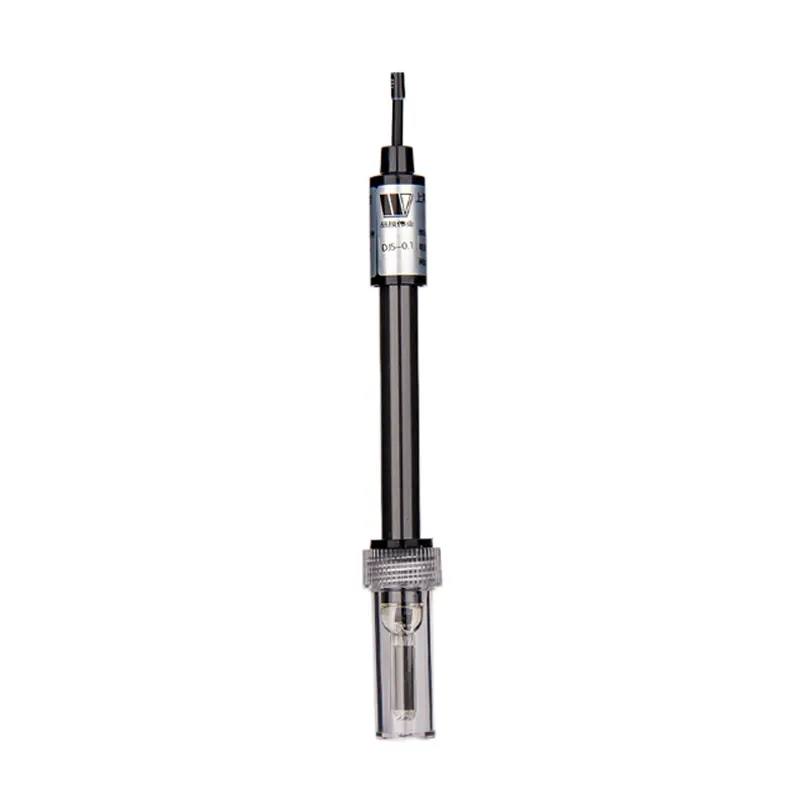
The DJS-0.1 is a conductivity electrode with cell constant 0.1±0.02, measuring 0.05–200 μS/cm. Glass shaft, Φ12×120mm, BNC connector. Designed for low-conductivity sample measurement including purified water, ultrapure water, distilled water and low-conductivity environmental water samples.
The DJS-0.1 conductivity electrode is a specialised low-conductivity electrode for accurate measurement of highly purified or naturally low-conductivity water samples. With a cell constant of 0.1±0.02 and a measurement range of 0.05–200 μS/cm, it is optimised for applications where the standard DJS-1N electrode (range 2–20000 μS/cm) lacks the sensitivity needed to resolve small conductivity differences at very low values.
The DJS-0.1 is the electrode of choice for pharmaceutical water monitoring — including purified water (PW) and water for injection (WFI) quality verification — as well as laboratory reagent water grade checking, boiler condensate and feed water analysis, environmental precipitation and rainwater surveys, and semiconductor and electronics manufacturing process water control. At these low conductivity levels, even minor contamination produces measurable changes, and the DJS-0.1’s low cell constant ensures the instrument can detect and quantify these differences reliably.
The glass shaft (Φ12×120mm) provides chemical resistance in aqueous samples, and the standard BNC connector ensures compatibility with all Skill Scientific DDS and DDB conductivity meters. The DJS-0.1 is available as an optional electrode for all DDS and DDB series instruments.
| Model | DJS-0.1 |
| Description | Conductivity Electrode |
| Measuring Range | 0.05 – 200 μS/cm |
| Cell Constant | 0.1 ± 0.02 |
| Shaft Material | Glass |
| Fill Solution | 0.001 mol/L KCl |
| Dimensions | Φ12 × 120 mm |
| Connector | BNC |
The DJS-1N has a cell constant of 1.0 and covers 2–20000 μS/cm — the standard choice for drinking water, environmental and general laboratory conductivity measurement. The DJS-0.1 has a cell constant of 0.1, ten times lower, covering 0.05–200 μS/cm. At very low conductivity values, a low cell constant electrode produces a larger, more resolvable signal, providing better accuracy and stability for low-conductivity measurement. For samples below 2 μS/cm, the DJS-0.1 is the correct electrode; above 200 μS/cm, switch to the DJS-1N.
The DJS-1N uses 0.01 mol/L KCl fill solution, while the DJS-0.1 uses the more dilute 0.001 mol/L KCl. Using a higher-concentration fill solution in a low-conductivity electrode would cause contamination of the sample by ions leaching from the electrode, artificially raising the measured conductivity. The more dilute 0.001 mol/L KCl fill solution minimises this effect, ensuring accurate measurement of very low-conductivity samples.
The DJS-0.1 is effective from 0.05 μS/cm up to 200 μS/cm. For samples above 200 μS/cm — including most drinking water, tap water and environmental surface water — the DJS-1N (range 2–20000 μS/cm) is the appropriate choice. Using the DJS-0.1 outside its recommended range will reduce measurement accuracy. For a laboratory measuring both purified water and standard water quality samples, it is recommended to have both electrodes available and select the appropriate one based on the expected sample conductivity.
Rinse with high-purity distilled or deionised water before and after each measurement session — avoid tap water, which may introduce contamination at these low conductivity levels. Store the electrode tip immersed in 0.001 mol/L KCl solution between uses to maintain electrode equilibration and prevent drying. Handle carefully to avoid contamination of the electrode surfaces from skin oils or airborne particles, which can significantly affect readings at very low conductivity values. If readings appear elevated or unstable, clean by soaking briefly in dilute HCl, then rinse thoroughly with high-purity water before recalibrating.
For pharmaceutical and critical purity water applications, calibrate before each measurement session using an appropriate low-conductivity standard solution (e.g., 146.5 μS/cm standard diluted as needed, or a certified low-conductivity reference). For routine quality checks, a daily calibration check is recommended. The electrode constant should be verified whenever the electrode is cleaned, replaced or if readings appear inconsistent with expected sample values.
Before You Go — Get a Free Quote