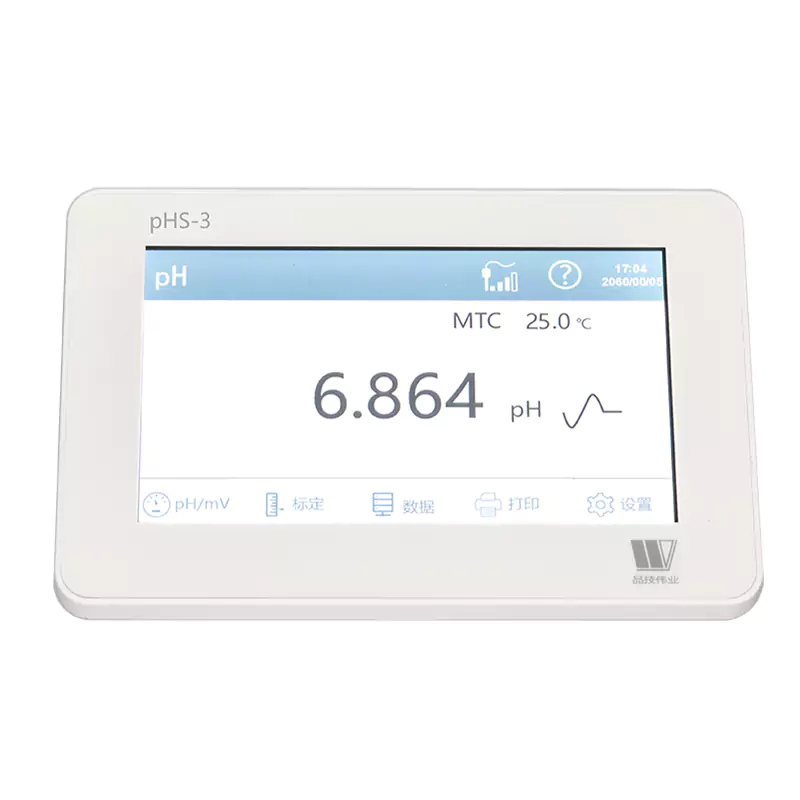
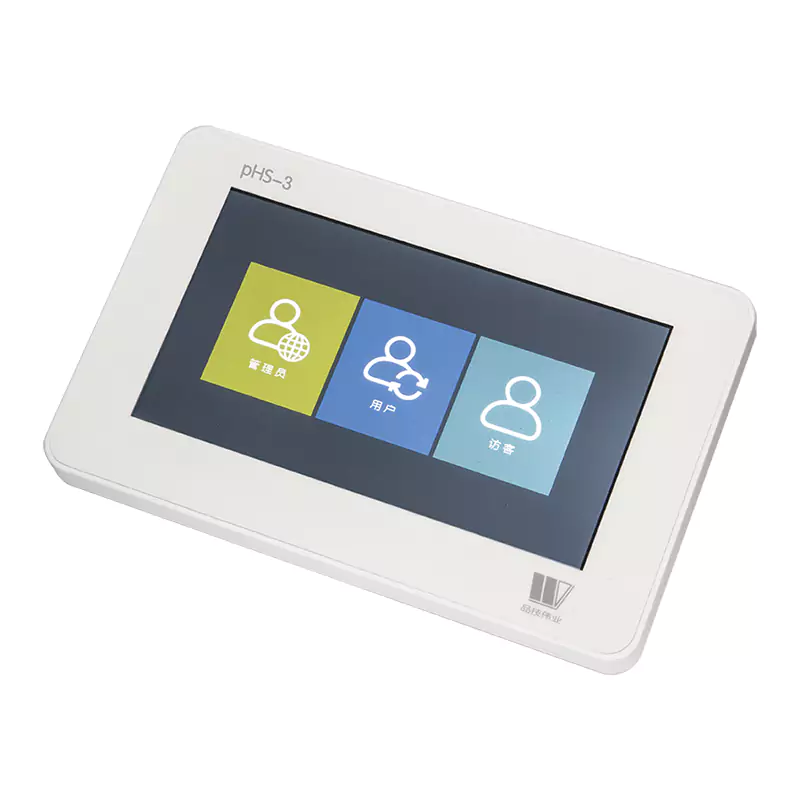
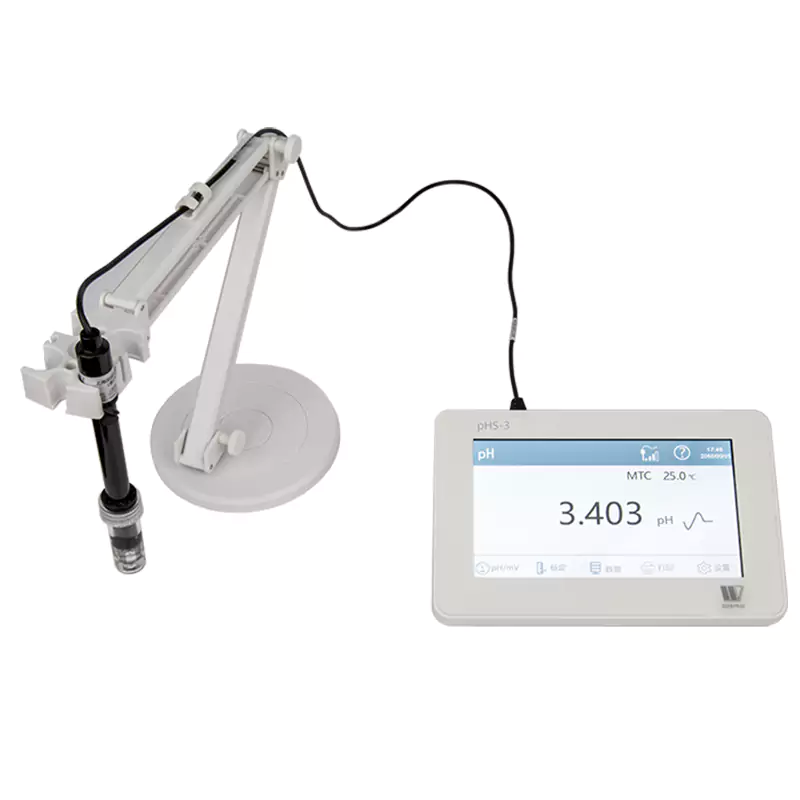
The pHS-3 benchtop pH meter is a professional-grade laboratory instrument designed for demanding electrochemical measurement tasks. Equipped with a large 7-inch color TFT touchscreen and Metro-style interface, it delivers an intuitive user experience with no compromise on measurement accuracy. A full ±0.01 pH accuracy across a wide -2.00 to 20.00 pH range makes it equally capable in routine water quality testing and specialized research environments.
● User management: Administrator/user/visitor 3 level control.
● Calibration management: Auto-calibration from 1 to 5 PTS; pH buffer Auto-ID and support self-define.
● Data management: Store up to 1500 data points.
● Printing management: Real-time/historical data printing compliant with GLP standards.
● Helper function: Click on “?” anytime to view the operation manual.
● 7″ color touch screen with Metro display, EN lanague.
● Electrode monitoring
| Model | pHS-3 | ||
| Measuring Range | PH | (-2.00~20.00) pH | |
| mV | (-2000~+2000) mV | ||
| TEMP | (-5.0~110.0) ℃ | ||
| Resolution | PH | 0.01 pH | |
| mV | 1 mV | ||
| TEMP | 0.1 ℃ | ||
| Accuracy (±) | PH | ±0.01 pH | |
| mV | ±0.02 %FS | ||
| TEMP | ±0.2 ℃ | ||
| Stability | (±0.01pH±1d)/3h | ||
| Sensor (included) | E-331D + T-820D | ||
| Connector to Meter | BNC / RCA / Binding post | ||
| Display | 7″ Color TFT Touchscreen | ||
| Electrode Holder | Included | ||
| TEMP Compensation | (-5.0~110.0) ℃ Auto / Manual | ||
| Calibration | 1-5 point | ||
| pH Buffer | Auto-ID (JJG119; DIN19266; DIN19267; USA) / Self-define | ||
| Data Storage | 1500 data points | ||
| Connectors | USB / RS232 | ||
| Printing | GLP standards | ||
| User Mgmt | Password protection | ||
| Dtae/Time | Yes | ||
| Prompt Tone | On/off | ||
| Power | DC: 12V | ||
| Operating TEMP | 5℃~40℃ | ||
| Humidity | ≤80% | ||
| Dimensions (mm) | ≈ 200×130×60 | ||
| Weight (kg) | 1 | ||
The pHS-3 features a 7-inch color TFT touchscreen with Metro-style interface and supports up to 5-point calibration and 1500-point data storage. The pHS-3C uses a smaller digital display and is designed for more standard laboratory use with 3-point calibration. The pHS-3 is recommended for applications that require GLP printing, user management, and larger data storage capacity.
The pHS-3 automatically identifies buffers from four standard sets: JJG119 (Chinese national standard), DIN19266 and DIN19267 (German/European standards), and USA standard buffers. The instrument also supports user-defined buffer values, allowing calibration with any custom pH standard solutions your laboratory requires.
Yes. The pHS-3 is equipped with standard BNC, RCA and Binding post connectors, making it compatible with most laboratory-grade pH and ORP electrodes from major manufacturers. For best results, we recommend using Pinji-brand electrodes (E-series) which are calibrated and validated for use with this instrument. Contact our team for application-specific electrode recommendations.
The pHS-3 supports direct connection to a compatible serial printer via RS232 or USB. In real-time printing mode, each measurement is automatically printed with date, time, operator ID, calibration data and measurement result. In historical data mode, stored records can be batch-printed. The printed output format meets Good Laboratory Practice (GLP) documentation requirements including instrument identification and traceability information.
The pHS-3 has both USB and RS232 ports. For PC connection, install the included USB driver and PC software (available on the Downloads tab). Data can be exported in CSV format for import into LIMS, Excel or other data management systems. RS232 connection is available for legacy systems or printers.
The main unit requires minimal maintenance — periodic cleaning of the housing and regular calibration checks. The pH electrode (E-331D) should be stored in electrode storage solution (3 mol/L KCl) when not in use, cleaned with distilled water after each use, and reconditioned if readings become sluggish or inaccurate. We recommend recalibrating before each measurement session and replacing the electrode every 12–18 months under normal laboratory use. Refer to the electrode manual for detailed maintenance procedures.
Before You Go — Get a Free Quote